Superbug That Baffled Scientists for a Decade Solved by AI in Just Two Days
AI News 24/02/2025 23:31
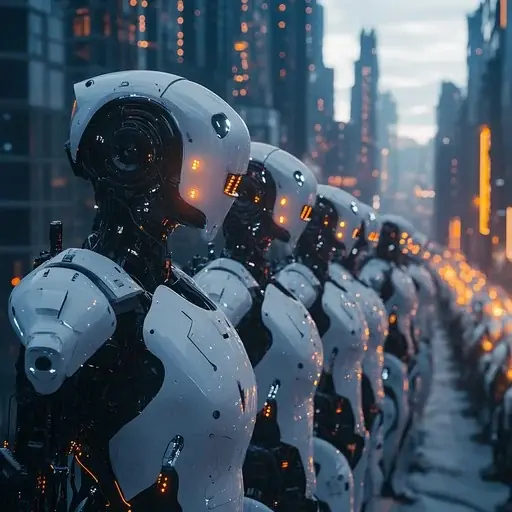
In a groundbreaking move for the robotics industry, California-based company Figure AI has announced ambitious plans to manufacture 100,000 humanoid robots within the next four years. Leveraging cutting-edge AI technology and strategic partnerships with industry giants BMW, OpenAI, and Microsoft, the company aims to redefine the role of humanoid robots in industrial and commercial applications.
A Strategic Approach to Growth
Figure AI CEO Brett Adcock recently shared insights into the company's vision in a LinkedIn post, emphasizing a targeted strategy over broad market penetration. "Early on, it's more efficient for us to grow vertically within a few clients than to spread out across many," Adcock stated, highlighting the importance of deep integration with select major partners rather than immediate mass-market deployment.
BMW: A Game-Changer for Humanoid Robotics
One of Figure AI’s key partners is BMW, marking a historic moment as the German automotive giant integrates humanoid robots into its production lines for the first time. According to BMW’s official website, the company has already conducted trials using Figure AI’s ‘Figure 02’ robot in real-world manufacturing conditions, signaling a potential paradigm shift in the automotive industry.
"With an early test operation, we are now determining possible applications for humanoid robots in production. We want to accompany this technology from development to industrialization," said Milan Nedeljković, BMW AG Board Member for Production.
During these trials, the ‘Figure 02’ robot successfully handled intricate tasks such as placing sheet metal parts into specialized fixtures, actively contributing to the car body assembly process. The results indicate that humanoid robots could soon play an integral role in automotive manufacturing, optimizing efficiency and reducing reliance on human labor for repetitive tasks.
The Mystery of the Second Major Client
While BMW's involvement is publicly confirmed, Figure AI’s second major client remains a well-kept secret. Adcock described this partner as “one of the biggest US companies,” hinting at large-scale deployments that could significantly drive down production costs and accelerate AI-driven advancements.
“Between both customers, we believe there is a path to 100,000 robots over the next four years,” Adcock revealed, underscoring the scale and confidence of Figure AI’s expansion plans.
Advancing Humanoid Robotics: The Road Ahead
Figure AI's humanoid robots, including the ‘Figure 01’ and ‘Figure 02’ models, are engineered for commercial and industrial applications. Earlier iterations faced challenges in speed and dexterity, but recent breakthroughs have enhanced their capabilities, making them increasingly viable for real-world deployment.
For instance, the ‘Figure 02’ model moves at 1.2 meters per second (approximately 2.68 miles per hour), closely matching an average human walking pace. The company is already developing the next-generation ‘Figure 03,’ which promises further advancements in speed, agility, and AI-driven adaptability.
A Competitive Landscape in Robotics Innovation
Figure AI’s aggressive push into humanoid robotics places it in direct competition with established players like Tesla, Agility Robotics, and Unitree. The US remains a hotbed for robotics innovation, but China is rapidly emerging as a formidable rival, with eight of the world’s top 16 humanoid robotics companies based there, according to a recent Forbes article.
Beyond industrial applications, the potential uses for humanoid robots span logistics, healthcare, and even domestic assistance. While Figure AI harbors long-term ambitions for both commercial and consumer markets, its immediate focus remains on revolutionizing industrial automation.
With the backing of major partners and an aggressive growth strategy, Figure AI is positioning itself at the forefront of the humanoid robotics revolution. The next four years will be critical in determining whether the company can turn its ambitious vision into reality, reshaping industries and redefining human-robot collaboration along the way.